

What is protected decides the design, so it comes before the drawing
Not a neighbourhood group, and not a guess off a website
BC Landscape and Nursery Association standards
Maillardville, Austin Heights, Westwood Plateau and Burke Mountain
Maillardville, which is BC's only francophone neighbourhood, along with Austin Heights and the streets down toward the Fraser. Flatter ground, established gardens and mature street trees.
The middle band, between the lowlands and the hillside. Family lots from the sixties and seventies, generally workable ground and the most straightforward access in the city.
Roughly 60 m at its foot to 400 m at the top. Slope on almost every lot, and the higher you go the more the wind and the exposure start to matter to what will actually establish.
The newest building in Coquitlam, a lot of it backing onto greenbelt with heavy tree cover. It is also the one neighbourhood the tree bylaw names specifically.
| Part of Coquitlam | What we usually find | How we approach it |
|---|---|---|
| Maillardville and Austin Heights | The older core, smaller lots, established gardens and mature street trees | Most of the protected trees in the city sit on lots like these, so the measuring happens first |
| Central Coquitlam and Ranch Park | Family housing from the sixties and seventies, reasonable access, generally workable ground | The most straightforward projects in Coquitlam, and usually the quickest to price |
| Coquitlam Centre and Eagle Ridge | Denser, a lot of townhouse and strata frontage mixed with detached housing | Shared boundaries and parking windows matter more than the planting does |
| Westwood Plateau | Slope on nearly every lot, from about 60 m up to 400 m, with real wind exposure near the top | Planting chosen for exposure, and where material can be landed decides the sequence |
| Burke Mountain and the Coquitlam River side | The newest building, much of it against greenbelt with heavy tree cover | The bylaw names this neighbourhood, so nothing gets cut before the position is confirmed |
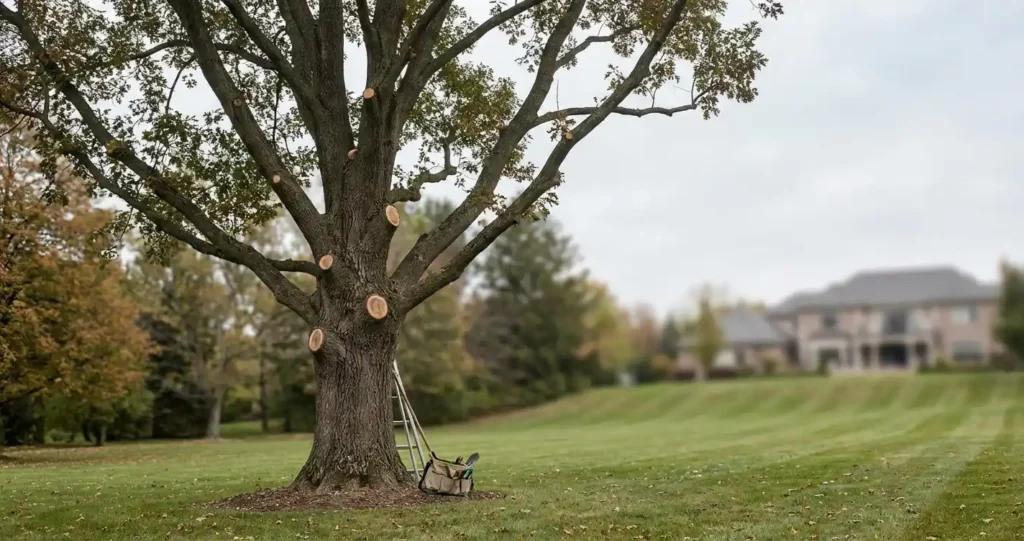
It depends how many and how big. Under the City of Coquitlam’s Tree Management Bylaw a protected tree is 20 cm or more across, measured 1.4 m from the ground, and you may take up to two protected trees in a year without a permit. Beyond two in the same year you need one, and replacement planting can be a condition of it.
No, and this is the bit that catches people out. Two protected trees in a year is the allowance; a third in the same year needs a permit. And if you are redeveloping on Burke Mountain, the bylaw names that neighbourhood specifically and the permit process applies.
The City of Coquitlam. Not a neighbourhood or residents’ association, which has no role in permitting whatever you may read elsewhere. We will tell you what we think applies and then point you at the City to confirm it, because we are not the authority either.
No. They are separate municipalities with their own bylaws and their own penalties, so a figure or a rule you have read about one does not carry over. The first thing we check is which city the address is in.
Usually elevation and trees. Coquitlam runs from near sea level to over 400 metres, and Burke Mountain is at the upper end with a lot of greenbelt against it. Less light, more root competition, more wind, and a shorter usable window in spring.
Usually, and the question is where material can be landed rather than whether the slope is workable. That is settled before the quote, because on a plateau lot it changes the sequence of the whole job.
Both. Plenty of Coquitlam work is a single garden bed or a cleanup. Where there is real tree cover most people end up on a schedule, because that is the only thing that stops it becoming a project again every spring.
It depends on access, slope and how much has to be dealt with before anything is planted. A flat Ranch Park bed and a terraced Burke Mountain frontage are not comparable. We look at it, quote in writing, and the number does not move.