
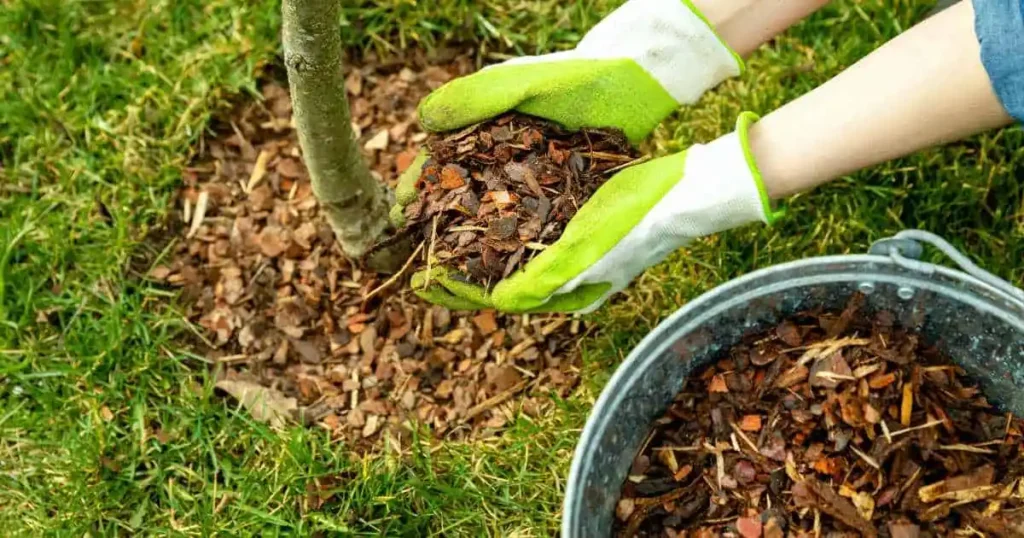
Mulch goes on at a depth the tree can live with
BC Landscape and Nursery Association certification
It stops the mulch doing half its job, so we leave it out
Haney, Albion, Silver Valley and Whonnock

The ground inside a big conifer's reach gets a light covering and no more. It is the one part of a Maple Ridge bed where less material is the skilled choice, not the cheap one.
Where the trunk widens into the roots stays uncovered. Material banked against bark holds damp on the one part of the tree that needs to stay dry.
Needles and leaf litter under a conifer are doing the same job as the mulch you are paying for. We work over that rather than raking it out first.
| Maple Ridge area | What we usually find | What it changes |
|---|---|---|
| Haney and the town centre | Older lots, established planting, beds that have been topped up for years | Straightforward top ups, and the smallest volumes in the district |
| Albion and Cottonwood | Newer subdivisions, young trees, builder beds that were never finished properly | More volume than owners expect, and fabric under the existing mulch more often than not |
| Silver Valley and Thornhill | Hillside lots with real grade and heavy conifer cover above the town | Coarse material so it stays put, and depth kept down over roots |
| Whonnock and Ruskin | Rural residential and acreage, long frontages, mature standing timber | Loose loads usually beat a spread job at this size of property |
| Hammond | Compact older streets near the river, small gardens, mature street trees | Small precise orders, and access worth checking before the day |
Usually, yes, and it is worth being honest that reseeding it again is not. Grass under an established fir is competing for water and light it cannot win, so the sensible move is to stop asking it to. A mulched bed in the same spot looks deliberate and costs less over a few years.
Not normally. Cutting it down hard and mulching over the top disturbs the tree roots less than stripping turf does, and on a treed lot that matters more than the tidier method. Where the grass is thick and vigorous it gets dealt with differently, and we will say which applies.
Less than on an open bed, and knowing how much less is the whole skill. A conifer does its feeding very near the surface, so a thick blanket over that zone is how a healthy tree begins failing, slowly enough that nobody connects the two. We set the depth against the tree rather than against a catalogue figure.
No, and we do not put it in. Fabric stops bark breaking down into the soil, which is half of what mulch is for, and surface roots grow into it so removing it later does damage. A clean bed edge and a sensible depth do more for weeds than a sheet does.
Yes, and there is no rush. A clean mulched bed is a finished look on its own, so plenty of owners live with it for a season and plant the following spring once they have watched the light. Planting goes into gaps between roots rather than through them.
They stay. Litter under a conifer is doing the same work as the bark you are paying for, so raking it out first is paying twice. We work over it, which also means less disturbance at root level.
No. We are a planting, bed and maintenance company, and tree removal is not something we do. Thinning a canopy to get light back is a pruning job, and where a tree genuinely has to come out you want someone whose trade that is.
Yardage, the grade, and how far the material has to travel from where a truck can park. On the rural lots that last one is the variable. We measure, quote in writing, and the figure holds.