
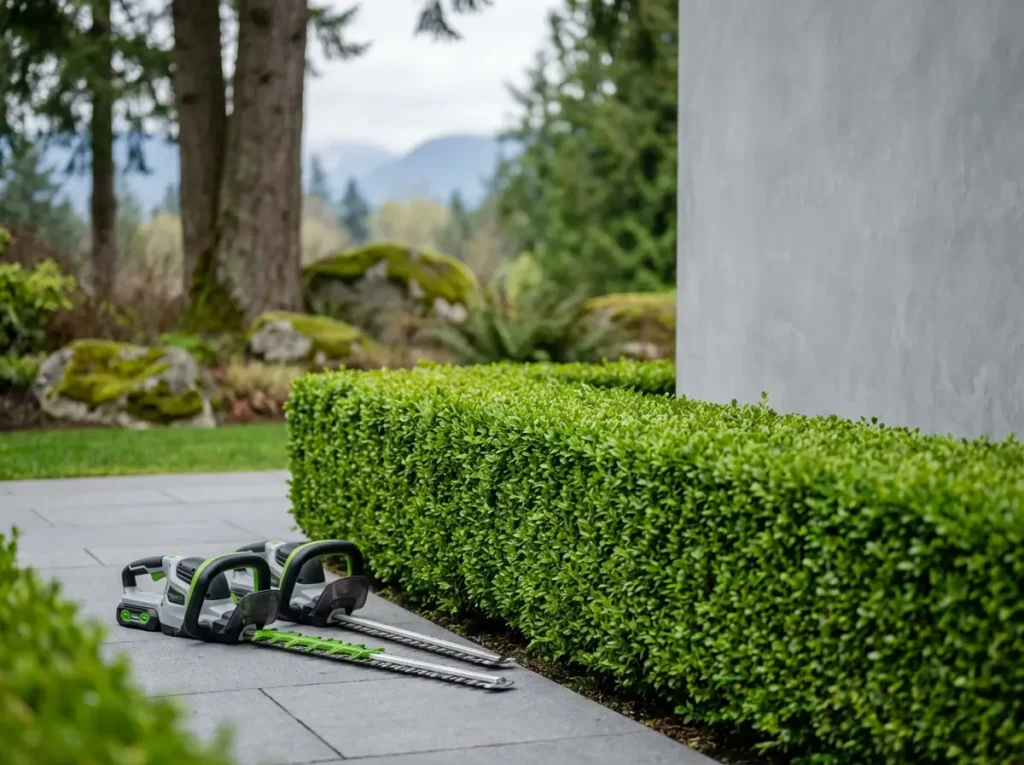
Summer heat and winter east wind both change what a hedge can take
No pile of clippings left at the kerb
BC Landscape and Nursery Association standards
Clearbrook, Matsqui, Sumas and Mount Lehman
Sitting well inland up the valley, Abbotsford gets hotter and drier spells than Delta or Richmond ever see. An exposed hedge face can scorch, and a hedge cut hard just before a hot stretch will show it.
Winters here bite deeper than on the coast. Cut edges made late in the season do not heal before the cold arrives, which is how you get dead tips along a whole run.
Cold dry outflow wind funnels down the valley in winter. It pulls moisture straight out of evergreen foliage while the ground is frozen and the roots cannot replace it.
Matsqui, the Sumas Prairie and the acreages out west have hedge runs measured in tens of metres, often planted as windbreaks rather than decoration.

| Area of Abbotsford | What we usually find | How we schedule it |
|---|---|---|
| Clearbrook and Townline | Established residential streets with mature cedar and laurel screening between neighbours. | Two cuts a year, held to the line |
| Matsqui and the Sumas Prairie | Flat open farmland with long runs and nothing upwind. Most of these hedges are doing real work as windbreaks. | Cut by the metre, never reduced hard |
| Auguston, Eagle Mountain and Sumas Mountain | Up on the slope, with more wind exposure and thinner ground than the flats below. | Windward face assessed before cutting |
| Aberdeen, Bradner and Mount Lehman | Rural west Abbotsford. Acreages, long driveways and hedge runs that go on for a while. | Scheduled visits, priced by the run |
| Clayburn, Straiton and Ledgeview | Older village streets and established gardens with hedges that have been in a long time. | More structural work, staged reduction |
It depends on the length and height of the hedge, the species, how far past where you want it the growth has got, and whether it is a suburban run in Clearbrook or forty metres of windbreak out on the prairie. We measure it, quote in writing, and the number does not move.
Twice a year suits most of them, usually late spring and late summer. What matters more here is when those cuts land: not going into a hot dry spell, and not so late in autumn that the cut edges meet a hard frost before they have hardened off.
In Abbotsford it is usually one of two things and they happen at opposite ends of the year. Brown on the south or west face after a hot summer is scorch. Brown that appears over winter is the dry east wind pulling moisture out while the ground is frozen. Neither is a disease, and cedar will not regrow from bare brown wood, so we reshape around it and tell you straight what is not coming back.
We would rather not, on cedar especially. Freshly cut foliage scorches much faster than established growth, so a cut going into a hot stretch can leave a hedge looking worse for the rest of the season. We will book it either side of the heat.
Yes, always. Everything we cut leaves with us and is disposed of properly. The haul away is inside the quoted price rather than added afterwards.
Yes. Runs out on Matsqui and the Sumas Prairie are cut in a single pass and priced by the run rather than shaped bush by bush. A windbreak is doing a job, so we keep the screen rather than reducing it hard.
We check before cutting. If there is an active nest we leave that section and come back rather than cutting around it and hoping.
Yes, on scheduled programmes, including commercial frontages where access hours matter.