

Wet soil wants less, not more, and we say so
BC Landscape and Nursery Association certification
You get the yardage in writing before anything is booked
Bonson, Osprey Village and the Town Centre
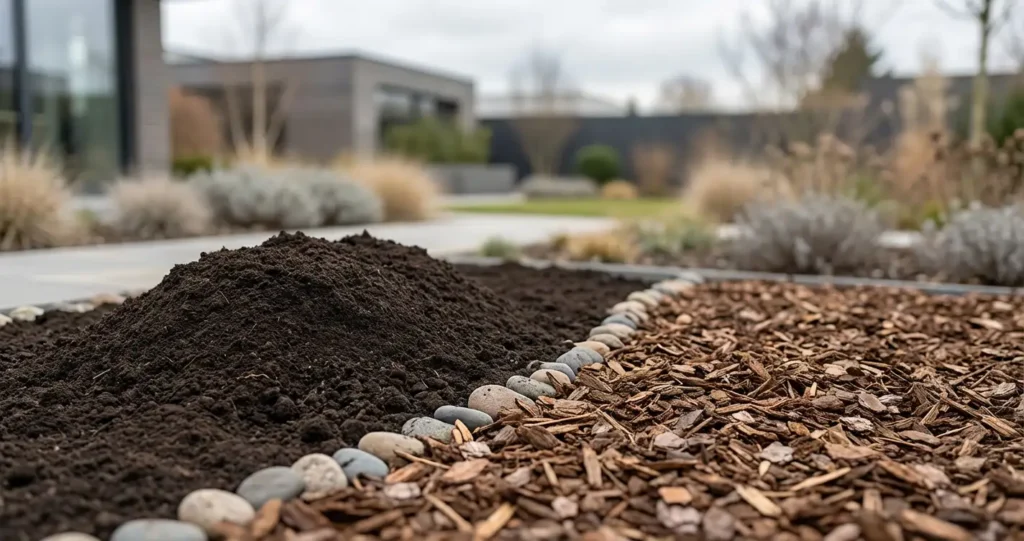

Where a garden meets a field or a dike path, the pressure comes from outside the bed. A cut edge with a clear line is what holds that boundary, and mulch alone will not.
Flat, open farmland means exposed beds. Light material on an exposed bed migrates, so the grade has to suit the site rather than the catalogue.
On ground this fertile the layer is absorbed into the soil sooner than it would be on drier land. That is not waste, it is the mulch doing its second job, and it means a smaller order next time.
| Pitt Meadows area | What we usually find | What it changes |
|---|---|---|
| Bonson | Newer subdivisions with builder beds, small lots, uniform planting | Modest volumes and a shallower depth than the bag suggests |
| Osprey Village | Compact waterfront housing near the Fraser, shared frontages, little private ground | Small precise orders, and often strata rather than private work |
| The Town Centre | Older established lots with mature planting and deeper beds | The one part of the city where volume is worth measuring properly |
| Toward the Pitt River and the dikes | Properties finishing at a dike path or open field, exposed and damp | Coarse material, a cut edge, and depth kept down |
| Pitt Polder and the ALR acreages | Farm parcels on old bog ground, long driveways, plenty of room | Loose loads make more sense than a spread job on ground this size |
Less deep than the usual advice, and the reason is the ground. With over 68% of the city inside a floodplain, most beds here already hold water, and a thick layer over damp soil keeps it cold and sodden. We would rather look at the bed and tell you what it can carry than quote a figure off a chart.
Because the ground is old bog and it is biologically busy. Bark breaks down into soil, which is the second thing mulch is for, and on fertile damp ground it happens faster. It means a top up rather than a rebuild, and a smaller order than the first one.
Coarse, in almost every case here. Fine material packs down and stops air moving, and on wet ground that is the combination that damages plants. Coarse material breathes, and it also stays put better on the exposed beds near the fields.
No, and it is worth saying plainly. If water sits in a bed for weeks the problem is where the water goes, not what is on the surface. Mulch over a drainage problem hides it for a season and then the plants tell you.
A little later than you might elsewhere. Letting a wet bed warm up and drain a bit first is worth more than getting the job done early, because sealing a cold wet bed in March slows everything behind it.
Yes. On the ALR parcels a loose load usually makes more sense than a spread job, because there is room to tip and the distances are long. In the urban neighbourhoods it is normally the other way round.
It should not, and on damp ground it matters more than usual. Material piled against a stem holds moisture exactly where the plant is most vulnerable, which is how an established shrub ends up rotting at the collar.
Yardage, grade and access set the number, and here the third one is rarely the problem: the residential streets sit close together, so there is usually somewhere sensible to work from. We measure, put it in writing, and the figure holds.